

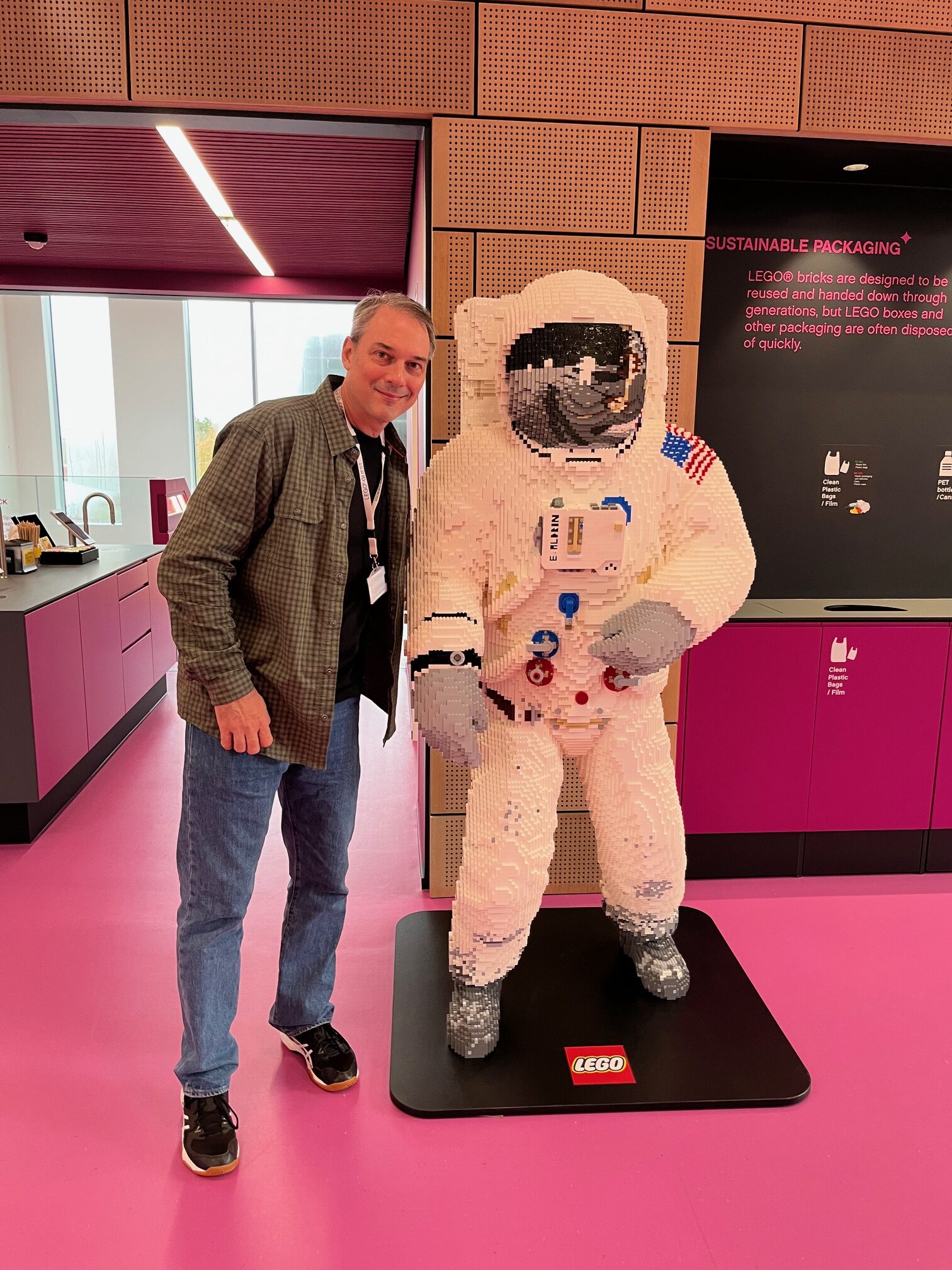
Visiting Lego HQ in Billund, Denmark
My Research
Bruce D. Homer is Professor of Educational Psychology at the Graduate Center of City University of New York, where he directs the Child Interactive Learning and Development (CHILD) Lab. Dr. Homer studies the role of digital technologies in children’s learning and development. His recent research includes projects investigating how digital play can support wellbeing and prosocial development in children and adolescents, as well as the development of social-cognitive competencies. Dr. Homer was a lead investigator on UNICEF’s Responsible Innovation in Technology for Children (RITEC) project funded by LEGO foundation. He has authored numerous research articles and chapters and is co-editor of the Handbook of Game-based Learning (MIT Press, 2020). Dr. Homer also collaborates with industry partners, providing design insights and evaluation of impact and efficacy of digital tools, and frequently speaks to parents and educators on the role of digital technology in children’s lives.
A current list of publications can be found here: Google Scholar Profile
.
Learning with Digital Media
My main line of work applies theories and findings from more basic research to study how cognitive, affective, social, and cultural factors influence the ways in which people learn in digital environments, including simulations and games. In the Molecules and Minds project, my first major work on learning with digital media, my collaborators and I developed and studied the design of effective computer-based chemistry simulations for high school students (e.g., Homer, Plass, Milne & Jordan, 2009; Homer & Plass, 2014). More recently, I investigated learning and cognitive skills development with digital games. I am interested both in the general issue of video games as a context for children’s cognitive development (e.g., Homer, Hayward, et al., 2013) and in the potential of games as tools for learning (e.g., Homer, Raffaele, & Henderson, 2020) and wellbeing (UNICEF Innocenti, 2024).
Sample publications:
- Homer, B. D., & Plass, J. L. (2014). Level of interactivity and executive functions as predictors of learning in computer-based chemistry simulations. Computers in Human Behavior, 36, 365-375.
- Plass, J.L., Homer, B.D., & Kinzer, C.K. (2015). Foundations of Game-based Learning, Educational Psychologist, 50(4), 258-283.
- Homer, B. D., Plass, J. L., Raffaele, C., Ober, T. M., & Ali, A. (2018). Improving high school students’ executive functions through digital game play. Computers & Education, 117, 50-58.
- Homer, B.D., Plass, J.L., Rose, M.C., MacNamara, A.P., Pawar, S., & Ober, T.M. (2019). Activating adolescents’ ’“hot” executive functions in a digital game to train cognitive skills: The effects of age and prior abilities. Cognitive Development, 49, 20-32.
- Homer, B.D., Raffaele, C. & Henderson, H. (2020). Games as Playful Learning: Implications of Developmental Theory for Game-Based Learning. In J.L. Plass, R.E. Mayer, & B.D. Homer (Eds), The Handbook of Game-based Learning (pp. 25-52). Cambridge, MA: MIT Press.
Social Cognitive Development
In a second line of work, I have investigated development of social cognition in children and adolescents. My early work focused on developments during the preschool years (e.g., Homer & Astington, 1997), but more recently I have studied later developments in advanced theory of mind (aToM). Central to this research was the development of the Flexibility and Automaticity of Social Cognition task (FASC; Hayward, Homer, & Sprung, 2018), which measures different components of aToM. Recently, my lab has developed and validated a computerized version of the FASC, using NLP to automatize scoring (Brodsky, et al. & Homer, 2021). I have investigated the neurophysiological substrates involved in aToM, often in research with special populations. For example, my colleagues and I were the first to identify that certain brain regions negatively affected by methamphetamine abuse are associated with aToM, and to suggest that this explains some of the social cognitive difficulties experienced by individuals with methamphetamine addiction (Homer, Solomon, et al. 2008). Current efforts in this line of work include exploring factors, such as executive functions, that contribute to the development of aToM in adolescence (e.g., Homer, Brodsky, & Plass, 2019) and investigating the development aToM in special populations, such as children with ASD (Brodsky, Bergson, Hayward & Homer, 2019).
Sample Publications:
- Homer, B.D. & Astington, J.W. (1997). The development of children’s understanding of second-order beliefs. Canadian Psychology, 38(2a), 89.
- Homer, B.D., Solomon, T.M., Moeller, R.W., Macia, A., DeRaleau, L. & Halkitis, P.N. (2008). Methamphetamine Abuse and Impairment of Social Functioning: A Review of the Underlying Neurophysiological Causes and Behavioral Implications. Psychological Bulletin, 134(2), 301-310.
- Hayward, E. O., Homer, B. D., & Sprung, M. (2018). Developmental trends in flexibility and automaticity of social cognition. Child Development, 89(3), 914-928.
- Brodsky, J. E., Bergson, Z., Chen, M., Hayward, E. O., Plass, J. L., & Homer, B. D. (2023). Language, ambiguity, and executive functions in adolescents’ theory of mind. Child Development, 94(1), 202-218
Digital Media and Wellbeing
I have explored ways that digital media can support wellbeing in children and adolescents. In Project HOPE, my colleagues and I developed and implemented a curriculum for a digital, game-based educational intervention for Syrian refugee children living in Turkey (Sirin, Plass, Homer, Vatanartiran, & Tsi, 2018). Overall, the intervention was successful, improving key measures for the children, and served as an effective proof of concept for digital game-based interventions to support the needs of refugee children. A recent project, funded by SSHRC – Canada (Callaghan, PI), used a play-based intervention with Rohingyan refugee children living in a camp in Bangladesh to examine the potential of collaborative play to promote pro-sociality. With the assistance of a local NGO, the intervention and assessments were partially delivered using tablet-based measures and interventions which I took the lead in developing and/or adapting. Overall, the intervention was successful in supporting development of prosociality (Callaghan et al., 2024).
Sample Publications:
- Sirin, S., Plass, J.L., Homer, B.D., Vatanartiran, S. & Tsai, T. (2018). Digital game-based education for Syrian refugee children: Project Hope. Vulnerable Children & Youth Studies, 13(1), 7-18.
- Homer, B.D., Ober, T.M., Rose, M.C., MacNamara, A.P., Mayer, R. & Plass, J.L. (2019). Speed Versus Accuracy: Implications of Adolescents’ Neurocognitive Developments in a Digital Game to Train Executive Functions, Mind, Brain & Education, 13(1), 41-52.
- Ali, A., Wolfert, S., & Homer, B. D. (2019). In the service of science: Veteran-led research in the investigation of a theatre-based PTSD treatment, Journal of Humanistic Psychology.
- Homer, B.D. & Plass, J.L. (2021). Using Multiple Data Streams in Executive Function Training Games to Optimize Outcomes for Neurodiverse Populations. In Fang X. (ed) HCI in Games: Experience Design and Game Mechanics. HCII 2021. Lecture Notes in Computer Science, vol 12789. Springer, Cham.
- Callaghan, T., Colasante, T., Muhammad, S., Corbit, J., Yavuz-Muren, M., Raffaele, C., … & Malti, T. (2024). Fostering prosociality in refugee children: an intervention with rohingya children. Monographs of the Society for Research in Child Development, 89(1-2), 7-109.
A Few Past Talks:
Homer, B.D. (2026, January). Online Gaming Today: Social Worlds, Esports & Digital Identity. Talk given as part of the briefing, CHECKPOINT REACHED: The Prevention of Violent Extremism and Online Gaming, to the United Nations, the Department of Home Affairs of Australia, the United Nations Interregional Crime and Justice Research Institute (UNICRI) and the United Nations Office of Counter-Terrorism (UNOCT), United Nations, New York, NY.
Homer, B.D. (2025, June). Fostering Digital Wellbeing in Teens: How parents can support their teens’ development of a healthy relationship with digital media. Workshop offered to parents of high school students by The Office of Pre-College Programs at Columbia University.
Homer, B.D. (2024, April). Digital Play that Supports Children’s Wellbeing: The RITEC Project. Invited talk at Joan Ganz Cooney Center at Sesame Workshop’s Wellbeing by Design Fellows event, New York, NY.
Homer, B.D. (2023, April). Designing Tech for Kids’ Well-being. Invited talk at ASU+GSV Summit, San Diego, CA.
Media Coverage:
- Drs. Bruce Homer and Ann Cameron were interviewed for Monograph Matters on “The Impact of the Research to Educational Supports” – a discussion of implications of research by Callaghan et al. (2024), Fostering Prosociality in Refugee Children: An Intervention With Rohingya Children.
- Dr. Homer appeared as a guest on NPR’s Science Friday to discuss “Can Video Games be Used as Teaching Tools?”
Courses Taught:
- Cognitive Development and Learning Processes in Education
- Research Methods in Educational Psychology
- Advanced Seminar in Technology and Learning
- Seminar in Special Topics: AI in Learning & Development